
The following list is in alphabetical order and include individuals who are interred in the Historical Chinese Section (for more information see historical page)
Type the first or last name of the individual you are searching for in the search bar, then scroll down the list to find the names that match, which will be highlighted in blue. To view all information available about the specific individual, scroll right using the scroll bar at the bottom of the list.
Information on Chinese Names:
“Ah” is a generic prefix to a name. Cantonese speakers like to use two words when naming anything, so rather than use a single name, they add Ah in front to make it a duplet.
If a woman’s name is Lan, then she is called either Ah Lan or Lan Lan. The simple doubling of the name is also common, and is more of an affectionate term.
As for people coming to “the west” it is quite likely that Ah was then included as a persons official name by government officials.
Other examples of Cantonese prefixes:
Sin San = Mr Example: Ho Sin San = Mr Ho
Taai Taai = Mrs Example: Ho Taai Taai = Mrs Ho
Siu Je = Miss Example: Ho Siu Je = Miss Ho
Other prefixes or titles:
Goh Goh = Older Brother (generic for an older guy about your age or a senior just above you in a company)
Je Je = Older Sister (pronounced like chair chair)
Sook Sook = Uncle (or family friend)
History of the Chinese section: (for more information check out the history page)
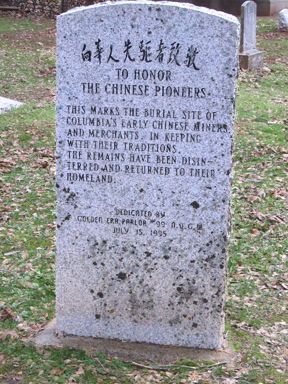
1995 July 15 – A Memorial was erected for the Chinese buried/removed in the cemetery. It states: To Honor the Chinese Pioneers
This marks the burial site of Columbia’s early Chinese miners and merchants. In keeping with their traditions, the remains have been disinterred and returned to their homeland.
Dedicated by Golden Era Parlor #99 N.D.G.W. July 15, 1995
This refers to when in the 1930s the Chinese remains are sent home. The practice of secondary burial and removal meant that many former cemeteries are considered as having no Chinese buried there. This is not a valid conclusion because not all bodies were removed and returned to China; in particular, women (many of whom were prostitutes) seldom participated in the arrangements which funded the systematic removal. Others were not exhumed because they failed to pay for the service.
 Columbia Historic Cemetery